
Saying No
Is Not Enough

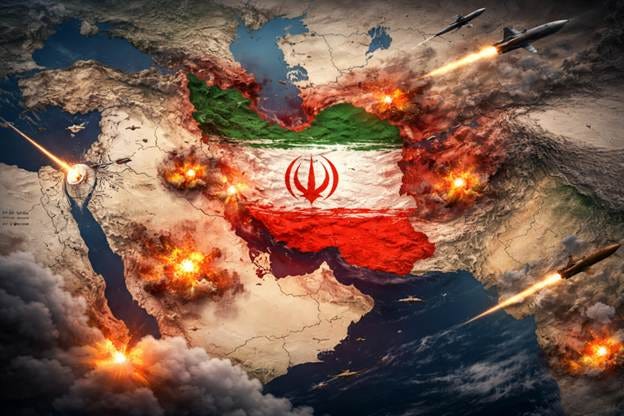
This is a follow up to last Sunday’s post.
I would argue that it is critical to provide a framework for a new foreign policy, one that could take us away from the dangerous path we have been on for much of the last 40 years (or, perhaps, for much of US history). Saying no is not enough!
With regard to the Middle East, such a framework requires that we begin by looking at the past and the consequences of US forever wars. This first article asks us to understand that Trump and his military adventurism are not a break from the past, but rather the logical extension of the road we’ve been traveling. It frames the consequences of the US forever wars as “blowback”, the unintended adverse results of a political action or situation. As the article concludes, “we reap what we sow; the chickens, in time, invariably come home to roost.”
The second article focuses on another adverse result of the war in Iran and the massive build up the military required for this and other wars of choice to maintain the US empire’s hegemony. As Trump keeps saying, military spending to wage war around the world requires drastic cuts to services at home. What he doesn’t say is who wins and who loses as a result. War and the preparation for war it turns out are ‘not healthy for children or other living things’.
The final article asks us to both halt and reverse our course. It offers a vision for a transformed role for the US in today’s interconnected world; one not based on striving for military hegemony, but rather one that projects a positive global role for the US. Such a revamping of US foreign policy would acknowledge the existence of a multipolar world and reject attempts to enforce a US ‘rules based international order’.
It is the only way to begin to resolve the multiple crises which the US and the world are currently facing. The question is, can the dysfunctional US political system find its way to this solution? More on that in future posts.
Blowback 2026: The Price of Empire and the Costs of War on Iran by Eric Ross, 4/3/2026, source TomDispatch
What will the costs of the latest round of illegal, ill-fated U.S. military adventurism in the Middle East amount to? Some of the toll is already clear. Washington has squandered billions of dollars on a reckless war of aggression against Iran. A merciless campaign of aerial bombardment has driven millions from their homes. American and Israeli airstrikes have rained destruction on 10,000 civilian sites and already killed more than 3,000 people in Iran and Lebanon. Among the dead are more than 200 children, many killed in a U.S. strike on a girls’ school, a war crime that evokes the grim precedent of such past American atrocities as the 1968 My Lai massacre in Vietnam or the 1991 Amiriyah shelter bombing in Iraq.
The latest war has also dealt a potentially fatal blow to our already battered democratic institutions. It’s a war neither authorized by Congress nor supported by the public. Instead, it was launched by a president who refuses to submit to the law or heed the will of the people, claiming in true authoritarian fashion that he is the law, and that he alone embodies the popular will.
Such democratic backsliding has, however, been decades in the making, a predictable result of longstanding imperial impunity. Yet we may rapidly be approaching a point of no return. Even George W. Bush, in launching his catastrophic wars of choice in the region, sought to manufacture consent and present the case before the United Nations. Today, there is neither the pretense of legality nor of legitimacy.
The costs associated with this latest criminal war, measured in human lives; the misappropriation of national resources; and the erosion of the rule of law will only continue to mount. Yet there is also a less visible, less immediate price tag for such wars. If the history of American interventions in the region offers any guide, the full bill will likely not become apparent for months, years, or even decades. When it finally arrives, however, it will carry a familiar name: blowback.
For that reason, it’s important at this moment to recall the lessons Washington appears determined to forget. From Afghanistan to Iran, Iraq to Libya, the record is unmistakable. Yet as long as the historical amnesia that grips this country’s political establishment remains unchallenged, the same cycles of escalation and reprisal will undoubtedly persist in the years to come, threatening to once again draw the United States (and much of the world) ever deeper into the abyss of forever war.
Oil and the engine of empire
While the post-9/11 “war on terror” is often invoked as the starting point of U.S. militarism in the Middle East, the roots of conflict there stretch back nearly a century. The violence and instability unleashed after the attacks of September 11, 2001, represented less a rupture with the past than a continuation of long-established patterns of U.S. policy. The seeds of the forever wars had, in fact, been planted decades earlier in the oil-rich soil of the region.
Direct American involvement began in the previous century in the years between the First and Second World Wars. By that point, petroleum had become not merely a valuable commodity but a strategic necessity for sustaining a modern industrial economy. The vast oil reserves discovered in the United States had propelled the American economy to global prominence and played a decisive role in fueling the Allied war effort during World War I. Yet policymakers in Washington understood that domestic reserves were finite. As petroleum became synonymous with power, economically, militarily, and politically, the United States increasingly turned abroad to secure new sources.
The Middle East emerged as a critical frontier in that search, drawing the region ever more tightly into the orbit of an expanding American empire. In 1933, Standard Oil of California secured an exploratory concession with the conservative monarchy of Saudi Arabia. The agreement created the Arabian American Oil Company (ARAMCO), laying the groundwork for the 1945 U.S.-Saudi oil-for-security partnership that would become central to Washington’s future influence over the region’s geopolitical order.
Over the years, the insatiable thirst for oil only drew the United States ever deeper into the region. By 1953, American intervention assumed more overtly coercive forms. That year, in coordination with British intelligence, the CIA orchestrated the overthrow of Mohammad Mossadegh, Iran’s popular prime minister, who had committed a cardinal sin in the emerging Cold War years. In 1951, he presided over the nationalization of his country’s oil industry in an effort to return sovereign control of its resources to the Iranian people by wresting them from the exploitative grip of the Anglo-Iranian Oil Company, the precursor to British Petroleum.
Despite his staunchly nationalist rather than communist credentials, a fact understood in Tehran, London, and Washington, Mossadegh would then be cast as, at worst, a dangerous proxy of the Soviet Union and, at best, a threat to regional stability (as in, American hegemony). The coup that followed ended Iran’s fragile democratic experiment, secured continued access to Iranian oil for Western companies, and restored the Shah of Iran to power. His regime would then be sustained by a steady outward flow of oil and a nearly endless influx of U.S. weaponry. With CIA backing, his secret police, SAVAK, would terrorize and torture a generation of Iranians.
Yet Washington celebrated this new arrangement, claiming that Iran had been transformed into an “island of stability,” and a cornerstone of the “twin pillar strategy,” in which Washington would outsource regional Cold War policing to compliant authoritarian allies in Iran and Saudi Arabia. Such subversion of nationalist movements and support for despotic monarchies, as well as the increasingly unequivocal backing of Israel, would generate intense backlash. Among the most visible early expressions of that was the 1973 OPEC oil crisis, demonstrating how U.S. policy in the Middle East could reverberate domestically.
But the first unmistakable case of blowback arrived in 1979 with the Iranian Revolution. In that country, discontent had been simmering beneath the seemingly stable façade of the Shah’s rule for years. When the monarchy collapsed after months of protests and repression, the Islamic Republic would fill the political vacuum, drawing on the theological language of Shi’ism and the political rhetoric of opposition to the Shah, the United States, and Israel.
In the U.S., those developments were largely stripped of their historical context. Americans were instead cast as the innocent victims of irrational fanaticism. Why do they hate us? was the refrain that echoed across the Western media and the answers offered rarely confronted the long history of intervention and exploitation. Instead, they defaulted to a supposed civilizational conflict with Islam, which was portrayed as inherently antagonistic to “Western values.”
Such explanations obscured an uncomfortable reality—that the U.S. had repeatedly undermined democracy across the region (as well as in other parts of the world) to advance its own interests. As a Pentagon commission report in 2004 acknowledged, the problem was not that people “hate our freedoms,” as President George W. Bush had reductively claimed, but that many “hate our policies.” In other words, the attacks on New York City and the Pentagon in Washington on September 11, 2001, were the ultimate, if deeply disturbing, expression of blowback.
Revolution and counterrevolution in the Persian Gulf
Those widely resented policies from Washington were reinforced by its overreaction to the 1979 upheaval in Iran. That country’s new leader, Ayatollah Khomeini, sought not only to transform Iranian society internally but envisioned the Islamic Republic as the opening move in a broader anti-imperialist struggle across the Middle East. For Washington and its reactionary regional allies, the specter of such potential revolutionary contagion posed a profound threat.
In January 1980, in an attempt to contain the Iranian regime, President Jimmy Carter articulated a new foreign policy position that placed the U.S. on a collision course in the region. The Carter Doctrine declared the Persian Gulf a “vital interest” of the United States, warning that any attempt by an outside power to gain control would be repelled by “any means necessary, including military force.” In that fashion, Washington asserted an explicit claim to a protectorate thousands of miles from its shores. The United States, Carter made clear, was prepared to send soldiers there to ensure uninterrupted access to oil.
The strategic reorientation that followed proved violent and far-reaching, while marking a shift away from East and Southeast Asia as the principal theaters of Cold War conflict. As Andrew Bacevich observed in his book America’s War for the Greater Middle East, if you were to measure U.S. involvement by the number of troops killed in action, the transformation was striking. From the end of World War II to 1980 almost no American soldiers were killed in the region. Since 1990, however, virtually none have been killed anywhere except in what Bacevich termed the “Greater Middle East.”
Measured in American lives alone, the subsequent costs would number in the thousands. Measured in civilians killed across the region, the toll would be vastly greater. Over the past several decades U.S.-led or -backed wars have contributed to the deaths of millions of people and the displacement of tens of millions more, producing one of the most devastating population catastrophes since the end of World War II.
Proxy wars and the escalation trap
The American shift toward the Middle East ensured that the United States would become deeply entwined in a cascade of conflicts. As regional actors moved either to defend a fragile status quo or exploit the upheavals that followed, Washington began instigating new conflicts in the region.
In Baghdad, Iraqi leader Saddam Hussein opposed the new government in Tehran on ideological and strategic grounds. The emergence of a revolutionary Shi’a state next door threatened his Sunni-dominated Ba’athist regime that ruled over a Shi’a majority in Iraq. At the same time, Saddam sought to exploit what he perceived to be Iranian weakness, pressing longstanding revanchist claims to the oil-rich borderlands of southwestern Iran.
Saudi Arabia viewed these developments with similar alarm. In the capital Riyadh, policymakers feared that revolutionary Shi’ism might threaten the legitimacy of the kingdom’s Sunni Wahhabi monarchy. The call for a Shi’a revolution also raised concerns about unrest in its oil-rich Eastern Province, where Shi’a workers faced economic exploitation and near colonial conditions. Similar anxieties reverberated across the other Gulf monarchies.
The United States responded by doubling down on support for the remaining pillars of its regional order, Saudi Arabia and Israel, while seeking to contain and roll back the perceived threat posed by Iran. Still interpreting regional upheaval through the prism of the Cold War, U.S. policymakers also expanded their involvement elsewhere. In Afghanistan, the CIA launched the largest covert operation in its history, channeling weapons and support to the Afghan mujahideen resisting the Soviet Union’s occupation of that country that began in December 1979.
The Soviet intervention itself was shaped by the shockwaves of the Iranian Revolution. Leaders in Moscow feared a militant Islam on their southern flank that might embolden similar currents within Muslim-majority regions of the Soviet Union.
In Iraq, the U.S. publicly tilted toward Saddam Hussein while simultaneously engaging in illegal weapons sales to Iran, with the funds received being rerouted to bankroll another American-backed war in Nicaragua. Meanwhile, the Lebanese Civil War, worsened by Israel’s 1982 invasion of Lebanon, created the conditions for the rise of Hezbollah, which presented itself as a defender of marginalized Shi’a communities against Israeli military aggression and sectarian violence.
By 1986, after escalating regional violence and spill-over, the administration of President Ronald Reagan took a step that paved the way for what would, in the next century, become Washington’s “War on Terror.” In April of that year, Reagan launched airstrikes in the dense heart of Tripoli on the home of Libyan leader Muammar Gaddafi, holding him responsible for acts of non-state terrorism abroad, including support for armed movements from the Palestine Liberation Organization to the Irish Republican Army.
That operation marked a significant escalation in the region and its justification would later be formalized as the Bush Doctrine: the claim that Washington could wage preemptive war anywhere against any state accused of supporting terrorism inside its country or outside its borders. That doctrine was no less illegitimate, illegal, or dangerous in the 1980s than it would become two decades later. As Daniel Ellsberg observed then (a point he would continue to press throughout his life, including after President Barack Obama ordered similar strikes on Libya in 2011), it seemed that the U.S. had “adopted a public policy of responding to state-sponsored terrorism with U.S. state-sponsored terrorism.”
In each instance, deeper involvement in the region produced deeper backlash. The U.S.-backed Afghan jihad helped give rise to Al-Qaeda in 1988 and paved the way for the Taliban’s seizure of power in 1996 and the failed 20-year American war in Afghanistan. The Iran-Iraq War of the 1980s set in motion a chain of events that culminated in the Gulf War of 1991, which laid the groundwork for the criminal 2003 U.S. invasion of Iraq. The instability that followed not only expanded Iran’s regional influence but contributed to the emergence of the Islamic State. In Lebanon, the power vacuum that Hezbollah came to fill resulted in the 1983 barracks bombing in Beirut, the deadliest day for U.S. Marines since Iwo Jima.
The lesson not learned
The pattern is difficult to ignore, despite our government’s persistent efforts to do so. Many of the actors Washington came to identify as its principal adversaries emerged either in direct response to U.S. policies or had themselves once been cultivated by Washington in pursuit of short-sighted strategic aims. In case after case, conflicts initiated or intensified by the United States appeared to subside, only to reemerge in new, more volatile forms. Intervention produced instability; instability served to justify further interventions; and the cycle only repeated itself thereafter.
There is little reason to believe that Donald Trump’s war against Iran will prove any different. By now, the historical record should make that clear, which is why we must oppose the violence being carried out in our name, as it is wrong, criminal, and immoral. We must oppose it for the sake of our common humanity, but also for our own sake.
After all, history tells us one thing: when we wage unjust wars that terrorize distant populations in far-off lands, the violence rarely remains confined there. Sooner or later, in one form or another, it returns. Violence begets violence, and imperial war has a way of boomeranging back upon those who initiate it. We reap what we sow; the chickens, in time, invariably come home to roost.
From The Nation, March 5, 2026, Mark Hertsgaard and Giles Trendle
The Iran War Is Also a Climate War
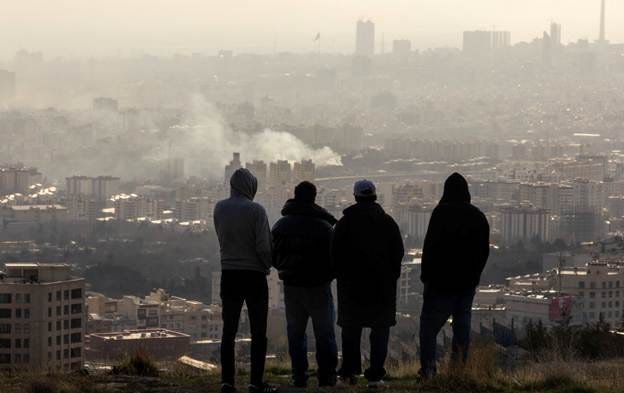
Men watch from a hillside as a plume of smoke rises after an explosion on March 2, 2026, in Tehran, Iran. (Majid Saeedi / Getty Images)
Climate change is not a peripheral part of what we’re seeing in Iran—it’s structurally embedded in modern warfare.
War makes climate change worse in many ways, and vice versa. The human costs of the US-Israel attack on Iran—the hundreds of people who have died, including a reported 175 young girls and teachers killed at the Shajareh Tayyibeh primary school—are a tragedy. The mounting economic risks—disrupted supply chains, rising energy prices, shaken stock markets—are ominous. The danger that this war of choice launched by two nuclear-armed states will escalate further, drawing in powers across the region and beyond, is alarming. And threaded through each of these concerns is the fact that modern warfare is inextricably linked with climate change.
The linkages flow in both directions. Wars unleash gargantuan amounts of planet-warming emissions: Russia’s war in Ukraine, for example, has generated emissions equal to the annual emissions of France. Those extra emissions drive deadlier heat, drought, storms, and other impacts that wreck livelihoods, destabilize economies, and spur migration, making armed conflict more likely. The British intelligence agencies MI5 and MI6 warned in January that climate disruption and biodiversity loss, if left unchecked, will cause “crop failures, intensified natural disasters, and infectious disease outbreaks…exacerbating existing conflicts, starting new ones, and threatening global security and prosperity.”
The outbreak of any war is bad news for the climate, just as the election of politicians hostile to climate action is. The climate implications of this new war are not the center of attention at the moment, but they are essential context for understanding what’s at stake. At a time when civilization is hurtling toward irreversible climate breakdown, to overlook the climate consequences of three of the deadliest militaries on Earth going to war would be journalistic malpractice.
Yet war has the perverse effect of pushing the climate story down the news agenda. The news media is event-driven, prioritizing breaking developments and immediate threats. And wars generate powerful images and dramatic narratives, which stoke the public appetite for news (at least in a war’s initial stages). Climate change, by contrast, typically unfolds over longer timescales. Except during acute disasters such as hurricanes or wildfires, the climate story tends to lack the urgency that garners headlines and boosts audience interest.
Is this a war for oil? The fact that Iran possesses the third-largest oil reserves on Earth inevitably raises the question, as does the long history of US-Iranian conflict over those reserves, including the CIA’s overthrowing a democratically elected leader who sought to nationalize them. When the US attacked Venezuela in January, President Donald Trump openly said that he wanted to gain control of that country’s vast oil reserves. Now more reporting is needed to establish just how much of a factor oil was in the decision to attack Iran.
What’s beyond dispute is that this war could not be fought without oil. The aircraft carriers, jet planes, and the myriad support systems they require gobble immense quantities of fossil fuels. Which helps explain why the US Department of Defense is the largest institutional emitter of greenhouse gases globally, as Neta Crawford, a professor at Oxford University, documents in her book The Pentagon, Climate Change, and War. Taken together, the world’s militaries have a bigger annual carbon footprint than all but three of the world’s countries.
Given this war’s immense implications—for the climate emergency and so much else—the question of why it was launched in the first place demands scrutiny, especially in view of the wild shifts in the Trump administration’s stated rationales. Within 24 hours of the first strikes, The Washington Post cited four administration sources as saying that “US intelligence assessments saw no immediate threat” from Iran. Nevertheless, Trump opted to attack, the Post reported, “after a weeks-long lobbying effort” by Israel, which views Iran as a bitter enemy, and Saudi Arabia, Iran’s long-standing regional rival and fellow petro-state.
As with most wars, so with climate change: The poor and the innocent suffer most. Climate change is not peripheral but structurally embedded in modern warfare. Journalists cannot fully and fairly cover a war this carbon-intensive, destabilizing, and consequential if its climate dimensions are treated as optional add-ons rather than core fact.
From Convergence, March 28, 2026 by Max Elbaum
Saying No to the Empire Is Not Enough
We won’t stop US wars, effectively tackle climate change, stave off US-style fascism, or halt the march to a nakedly might-makes-right world order without a vision for a transformed role for the US in today’s interconnected world.
The joint US-Israeli war against Iran puts an exclamation point on the Gaza genocide. It sends a message to the world from the regimes in Washington and Tel Aviv that if you didn’t get it before, you better get it now: We will do absolutely anything that our military strength allows us to do. There are no rules or international laws we are bound to acknowledge, much less respect. You have two choices: capitulate or be destroyed.
Most European governments, all too many regimes elsewhere, and major sections of the Democratic Party leadership here offer at most a few “process objections” to this level of ruthlessness but go with the flow.
This is a road to global catastrophe. It will accelerate a process that was already underway where every government in the world decides that their overriding priority must be increasing their military strength. And, like the US and Israel, they will conclude it is only prudent to crack down on opposition movements within their own countries.
New Thinking for the 21st Century
To halt and reverse this course, it is essential but not sufficient to build mass opposition to the war on Iran and all the other evils perpetrated by Washington, The US Left needs a foreign policy platform that projects a positive global role for the US and can gain enough popular support to catalyze a broader and deeper resistance to Trump 2.0 and then shape the policy of a post-MAGA government.
Developing that vision starts with facing the reality of an interconnected world where humanity’s very survival is in doubt. Without in the least softening our critique of the US-dominated world order that is passing away, it entails assessing the heightened dangers in the new order that Trump 2.0 is driving us toward. It requires learning lessons from the most positive experiences of longstanding antiwar, anti-racist, solidarity, and climate justice movements.
A valuable step in that direction would be taking a fresh look at a brief period 40 years ago when discussion of global cooperation and de-militarization – including massive cuts in military budgets and complete elimination of nuclear weapons – moved from the margins to the center of global politics. The high point was a 1986 US-USSR Summit during which President Ronald Reagan, an arch-hawk, was forced to seriously consider a pact with the Soviet Union to ban nuclear weapons. This unprecedented development stemmed from both grassroots pressure for peace and bold disarmament proposals and a stress on humanity’s common interest in survival coming from Soviet leader Mikhail Gorbachev’s program of “New Thinking” about foreign policy and perestroika (restructuring Soviet society).
In adopting “New Thinking” the Soviet leadership was not breaking new intellectual ground. As Gorbachev put it:
“New Thinking did not come out of the blue. It had its origins in the thought of Albert Einstein [“everything has changed except our thinking”] and Bertrand Russell; in the anti-war movements of the 1950s and 1960s…The core of New Thinking is the proposition that humankind’s common interests and universal human values must be the overarching priority in an increasingly integrated, interdependent world.”
What distinguished the Soviet initiative was that it was the first time that such a perspective was adopted as the official policy of a powerful state. And in a groundbreaking speech to an unprecedented meeting of Communist and other Left Parties and Movements on the 70th anniversary of the October Revolution, Gorbachev specified the ways the new Soviet policy created more favorable conditions to struggle for democracy, national liberation and socialism:
“[there are] two especially dangerous manifestations of capitalism’s objective laws: militarization and non-equivalent exchange with the developing world. However, they are only possible if they are backed by an appropriate governmental policy. But that policy will continue to enjoy support only so long as fear of the “Soviet threat” remains… and so long as people continue to believe there are ‘subjects’ of world politics and there are ‘objects’ – that is, the sphere of neocolonialism.
“Our perestroika…is eliminating the fear of the ‘Soviet threat’ and militarism is losing its political justification… We will not in any way renounce the genuine values of socialism. On the contrary, we will enrich them, and at the same time get rid of everything that distorted the humanitarian idea of our system. We do not expect our class adversary to become ‘enamored’ by us. We do not need that at all…
“For socialism, this policy secures a merging of its class interests as a system and the interests of all humanity. And for capitalism too there is no other sensible way than coexistence and competition… Joint action alone can lessen and remove the global danger of an ecological ‘heart attack’.”
A positive pole of attraction
Coming off the heightened nuclear fears of Reagan’s “Second Cold War,” audacious disarmament initiatives from one of that era’s two superpowers moved the idea of a nuclear-free world from a utopian dream to a practical possibility. The first World Climate Conference in 1979 had been a major step in alerting the world to the threat from global warming. The notion of global cooperation in building a sustainable and nuclear-weapons-free planet resonated with millions. It linked a vision of a changed international order with the concerns of individuals, families, and peoples for their own safety. In tandem with the antiwar and disarmament proposals from Jesse Jackson and the Rainbow Coalition, leading forces in the US resistance to Reaganism in the 1980s, these initiatives echoed the internationalist spirit that infused Dr. Martin Luther King, SNCC, and others in the radical wing of the Black-led 1950s-60s Civil Rights Movement.
The prospect of a post-Cold War “peace dividend” to boost economic development and a relaxation of tensions that would provide favorable terrain for popular movements gave the global Left a platform to offer “realistic hope.” Even socialism’s most ardent partisans realized in the 1980s that our North Star goal was not on any near-term horizon, and that goal appears even further away today. A Left that cannot offer any program for a safer and better world short of revolution will remain on the margins in this country.
A product of weakness as well as vision
The New Thinking vision captured the imagination of millions. But it was fleeting. This was because the radical shift in Soviet foreign policy, and the program of perestroika in general, grew out of the USSR’s deep economic and political weaknesses. Gorbachev was frank about this:
“Our country was sinking ever more deeply into stagnation. The economy was, for all intents and purposes, at a standstill. Ideological dogma kept intellectual and cultural activity in a straitjacket. The bureaucratic machine sought total control of society’s life while being unable to satisfy people’s basic needs….
“The militarization of the economy was a big burden for all countries, including the United States and its allies. Yet for our country, this cost was particularly high. In some years, total military spending amounted to 25-30 percent of gross domestic product, i.e., five to six times as much as in the United States and other NATO countries…. However, excessive armament did not make our security more reliable…. It was clear to me that continuing the arms race was not the path to lasting peace.”
While Gorbachev’s initiatives aimed at ending the Cold War made headway, his proposals for economic restructuring failed to yield positive results. The new openness in Soviet society (glasnost) succeeded in fostering a large-scale reckoning with the crimes of the Stalin era. But nationalist, chauvinist, and pro-capitalist movements rose and gained far more strength than working-class-based strivings to renew socialism. As the USSR hurtled toward collapse, Washington quickly returned to policies based on the worst of imperial ambition, using military force to show the world it was the global hegemon (via the first Gulf War) and vigorously pushing its recently initiated neoliberal economic model across the world.
The reasons for the Soviet collapse, which are of course connected to one’s assessment of the Soviet Union before 1985, remain a topic of sharp disagreement on the Left. But whatever one’s views in that debate, the so-far-unique experience of a powerful state taking Einstein’s “everything has changed” perspective as a starting point for a foreign policy stressing nuclear disarmament and environmental protection offers lessons for addressing today’s dangers.
Competing visions as the old order collapses
We’re in a moment when this quote from Gramsci is deservedly popular throughout the Left: “The old order is dying, and the new one is struggling to be born.” The different factions of the elite oligarchy are rushing into this “interregnum” to shape what comes next.
MAGA/Trump 2.0 argues that considering values like democracy or human rights when formulating policy are somewhere between naïve and treasonous, and that international agreements and multilateral institutions are simply shackles on US power. Staying number one in global “lethality” is the road to safety and prosperity for the “heritage Americans” who will dominate the country after solidifying white supremacy and removing or subordinating the various “others” who now live in the US.
The anti-MAGA wing of the US ruling class counters by arguing that the “rules-based” world order of the last 80 years was key to the wonderfulness of the American way of life. We just need to correct some of its “mistakes” (Vietnam, Iraq) to get back on the right track. Let’s preserve the “Western alliance of democracies,” keep China at bay, and use “soft power,” sanctions, multilateral institutions (where the US calls the shots), and “smart wars” to remain the world’s dominant power and bring safety and prosperity to the US people.
The Left has trenchant critiques of the racism and exploitation inherent in both variants of Washington’s imperial project. But we won’t win the majority of people to our side if we don’t go beyond critique to offer a positive vision of what the world can look like if we are in position to shape US policy.
Global cooperation as a powerful starting point
That vision has to address the hopes, fears, and pressing needs of the majority of US people. It has to be compelling enough to counter the American exceptionalist ideology that permeates US culture. Resting on the longstanding position of the US as the hegemonic global power and promoted unceasingly by the political class and mainstream media, the idea that the US is an inherently virtuous nation whose actions are those of the world’s “good guy” has long defined US “common sense.”
Antiwar and solidarity movements targeting Washington’s role in Vietnam, South Africa, Central America, Iraq, and most recently Palestine have spotlighted the destructive role the US has played in each case and at least temporarily won a portion of the population to an overall critique of US imperialism. At times, energetic social movements have convinced majorities of the importance of arms control agreements and aggressive steps to fight climate change. But we have yet to win a durable majority to a structural critique of imperial behavior and support for an alternative world order where all countries are on an equal footing, conflicts are resolved via diplomacy rather than violence, and a rapid transition away from fossil fuels is a worldwide priority. If we fail in that, a new incarnation of racist and authoritarian militarism may come roaring back even if we succeed in pushing MAGA out of power this time around.
The Left has always stressed the common interest of the global majority in fighting imperial exploitation. But in a period when the most dangerous threats to human life – climate change, nuclear war, global pandemics, obscene degrees of inequality – can only be addressed by joint action by all countries, the arguments against American exceptionalism and the way it makes US national sovereignty absolute become stronger and more urgent. This is why taking the concept of global cooperation based on common human interests from the “New Thinking” experience is the key starting point for formulating a radical foreign policy to put before the US people.
Building on that foundation, additional dimensions of international relations need to be addressed in formulating a comprehensive Left foreign policy: Among them are:
A framework for global rules for trade, debt, and other economic interactions among countries that tackles global inequality both between and within countries. There are a host of penetrating critiques of the neoliberal model of capitalist globalization to draw upon for this, as well as positive proposals for what Focus on the Global South calls “a healthy balance between national and international economies, diversity in economics and governance, and strengthening local and national economies.” (While Focus on the Global South uses the term “deglobalization” to describe such proposals, others offering thoughts in a similar vein use the terminology of “progressive globalization.”) There are also useful ideas to draw upon here from the 1970s proposals for a New World Economic Order and a New World Information Order put forward by the Non-Aligned Movement at a time when that alignment of governments in the global South had considerable unity and political initiative.
A set of proposals for reforming and strengthening international organizations, conventions, and treaties. The damage being done by Trump’s withdrawing the US from a host of global institutions is considerable, but a Left program must go beyond advocating a return to those institutions as they were structured pre-Trump. The demands of ongoing campaigns to reform the United Nations in a way that ends the Security Council veto power now held by the US, Russia, China, the UK and France, and to put the US under the jurisdiction of the International Court of Justice and others need to be considered and many adopted.
Renewal and enforcement of the International Convention on the Rights and Protection of All Migrant Workers and Their Families. Racist assaults on the rights of immigrants are a key part of the global Right’s drive for political power, and defense of migrants’ rights by figures, organizations and parties of the center and center left has been uneven at best. This is intimately linked to the need for cooperation to mitigate global inequality and the climate crisis, because those are among the strongest drivers of migration. But a positive vision of “new immigration order” also needs to be part of the foreign policy platform of the US Left.
As the last point on immigration indicates, in today’s world the boundary between “domestic” and “foreign” policies is very blurry. They are interconnected, and we will need to continue to make that intertwining visible and concrete for people—for example, contrasting the bloated military budget with gaping holes in programs that meet human needs; looking at the way the global spread of bird flu spiked the price of eggs, pointing out how climate change has intensified floods, blizzards, and fires that have ravaged communities; stressing the way militarism abroad comes back home in the form of militarized surveillance and valorizing a toxic version of masculinity. In that sense, a Left vision for a post-MAGA foreign policy is a necessary component of an overall program for a Third Reconstruction that moves the country toward a durable multiracial, gender-inclusive democracy on a peaceful, sustainable planet.
Amid a continuing genocide in Gaza and a killing-spree-of-choice war against Iran, the numbers of people saying “stop” to the guardians of empire is growing by the day. Fanning those flames of opposition and offering these millions a vision to fight for is the combination needed to accumulate the political power to transform the US role in the world.